Why it exists
Section 409A of the US tax code covers deferred compensation. A stock option granted with a strike price below the stock's fair market value counts as deferred compensation, and the penalties fall on the employee: the option can become taxable as it vests, plus an extra 20% federal tax and interest. An option granted at or above fair market value is outside 409A.
The catch is that a private startup has no market price. So the IRS regulations describe ways to set one that it will presume reasonable, a "safe harbor". The most used is an appraisal by an independent, qualified valuation firm. With a safe harbor valuation, the IRS has to show the value was grossly unreasonable to challenge it, rather than you having to prove it was right.
An example: Acme's strike price
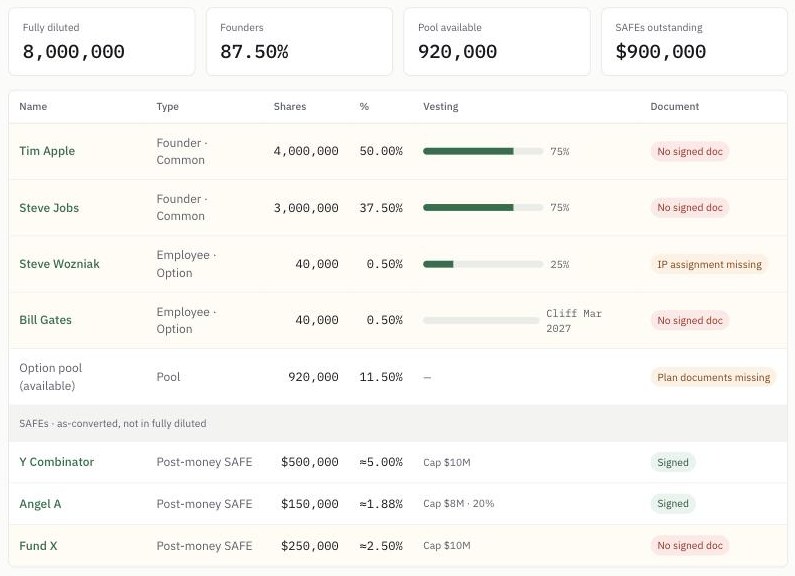
Acme, the sample company in Capfolder, granted options to Steve Wozniak in October 2025 and to Bill Gates in March 2026, both at a strike of $0.12 per share. For that to be safe, Acme needs a 409A valuation, dated before each grant and less than 12 months old at the time, that values the common stock at $0.12 or less.
Now imagine Acme raises a seed round at $1.00 per preferred share. That round is a material event. The old $0.12 valuation no longer reflects the company, and any option granted after the round needs a new 409A first. The new value for common stock will usually come out well below $1.00, because common stock has fewer rights than the preferred shares investors bought, and can't easily be sold.
When you need a new one
- Before your first option grant.
- At least every 12 months while you keep granting options.
- After a material event: a priced round, often a significant SAFE or note financing, an acquisition offer, or a big change in the business.
Many companies simply get a new 409A right after each round and once a year in between.
How a 409A is done
You send the valuation firm your cap table, financial statements, forecasts, and the terms of each share class and round. The firm values the company as a whole, then works out the value of one common share. Typical approaches:
- Market approach: uses your latest funding round (the "backsolve") or comparable companies.
- Income approach: discounted future cash flows, used more for later-stage companies with revenue.
- Asset approach: what the company owns, used for very early companies with little else to go on.
Then come the discounts: common stock ranks behind preferred, and there is no market to sell it. Discounts for lack of marketability are often in the 20–35% range. The board approves the final value, and grants after that date use it.
The regulations also allow very young companies to rely on a written valuation by someone with relevant experience instead of an outside firm (the "illiquid startup" method), under conditions. Most companies use an independent firm anyway, because the safe harbor is clearer.
Keep a simple log of every valuation: the date, the value per share, the provider, the date the board approved it, and the date it stops being usable. Check it before each board meeting where grants are on the agenda.
Key terms
- Fair market value (FMV): what one share of common stock is worth on a given date.
- Safe harbor: a valuation method the IRS presumes reasonable. If you use one properly, the burden is on the IRS to prove the value grossly unreasonable.
- Material event: something that changes the company's value enough that the old valuation no longer holds, such as a priced round or an acquisition offer.
- Backsolve: working back from the price in your latest round to a value for the whole company, then to the common stock.
- Discount for lack of marketability: a reduction because private shares can't easily be sold.
Getting one, step by step
- Pick a provider. Independent valuation firms, some cap table tools and some accounting firms offer them. Ask how they handle early-stage companies.
- Send the data: current cap table, the terms of each share class and SAFE, financial statements, forecast, and recent events.
- Answer the questions. The valuation team may call to understand the business and any upcoming events.
- Review the draft for factual errors, such as a wrong share count or missing SAFE.
- Board approval. The board adopts the value in a consent. Only then can it be used as a strike price.
- Keep the report with the board consent and note the date it expires.
Most early-stage 409A reports take one to three weeks. Plan for it before an offer goes out with options in it.
Common mistakes
- Granting options before you have a 409A. The strike price then has no support.
- Using an expired valuation. More than 12 months old, or older than your latest round.
- Backdating grants. The strike must match the value on the date the board approves the grant.
- Using the preferred price as the strike. It is allowed, but it overcharges employees for no reason.
- Losing the report. Investors and auditors ask for every 409A behind your grants.
In Capfolder
Each option grant stores its strike price, and Capfolder warns when an option is recorded without one. Keep the 409A reports with your company documents, next to the board consent that approved them.
Questions people ask
How long is a 409A valuation valid?
The safe harbor for an independent appraisal covers up to 12 months, unless a material event, such as a new funding round, happens first.
Do I need a 409A before granting options?
Yes, if you want a safe harbor for the strike price. Grant only after the board has approved a current valuation.
What happens if the strike price is below fair market value?
The option can fall under Section 409A. The employee may owe income tax as it vests, an extra 20% federal tax and interest.
Why is the 409A value lower than the price investors paid?
Investors buy preferred stock with extra rights, such as a liquidation preference. Common stock has fewer rights and can't easily be sold, so it is worth less.
Does a company outside the US need a 409A?
409A is a US tax rule. If you grant options to US taxpayers you should follow it; other countries have their own valuation rules.
Who approves the 409A value?
The board of directors adopts it, usually by written consent, before any grant uses it.
Can we grant options on the same day as a new 409A?
Yes, once the board has approved the valuation. The grant must use a value that is current on the grant date.
Sources
- 26 CFR § 1.409A-1: definitions, including the valuation safe harbors (primary source)
- Carta: What is a 409A valuation? (topic coverage)
- Cooley GO glossary: 409A
- IRS Topic 427: Stock options
Read next
Not legal or tax advice. Tax rules change and depend on your situation: check yours with a tax advisor or lawyer. Spotted a mistake? Tell us on GitHub.