
What an option pool is
Startups can't usually match big-company salaries, so they offer part of the upside instead: stock options. To do that cleanly, the company adopts an equity incentive plan and reserves a number of shares under it. That reserve is the option pool. Each time you hire someone and grant them options, the grant comes out of the pool. When someone leaves before their options vest, the unvested options go back in.
Three numbers describe a pool at any moment:
- Reserved: the total the plan allows.
- Granted (outstanding): options given to people and not yet exercised or cancelled.
- Available: what is left to grant.
A word on the name. In startups "ESOP" usually means the stock option plan. In the US the same letters also mean an Employee Stock Ownership Plan, a retirement trust that holds company shares for employees. That is a different thing with different rules. When someone says ESOP, it's worth checking which one they mean.
An example: Acme's 2025 plan
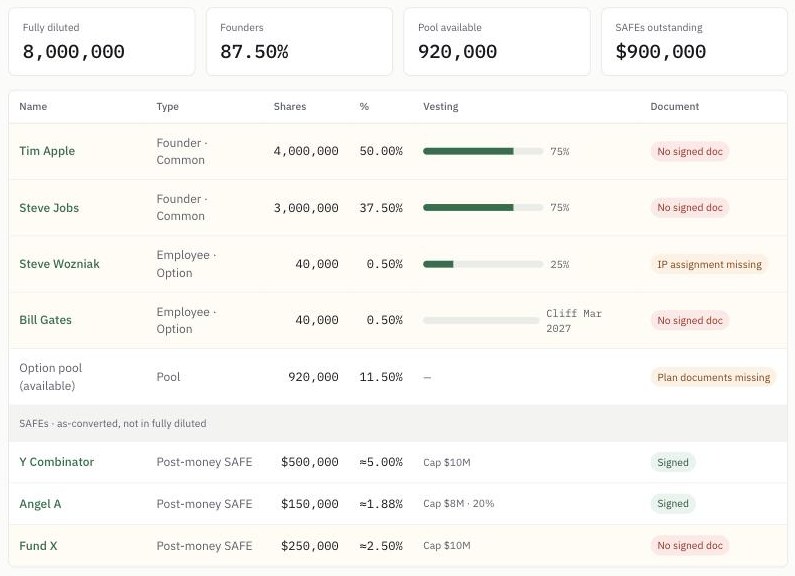
Acme, the sample company in Capfolder, adopted the 2025 Equity Incentive Plan with the board's approval on 30 September 2025 and reserved 1,000,000 shares. It then granted 40,000 options each to Steve Wozniak and Bill Gates, at a strike price of $0.12.
| 2025 Equity Incentive Plan | Shares | Of the pool | Fully diluted |
|---|---|---|---|
| Reserved | 1,000,000 | 100% | 12.5% |
| Granted: Steve Wozniak | 40,000 | 4% | 0.5% |
| Granted: Bill Gates | 40,000 | 4% | 0.5% |
| Available to grant | 920,000 | 92% | 11.5% |
The whole 1,000,000 counts in Acme's fully diluted total of 8,000,000, even the part nobody holds yet. That is why investors care about the pool: it is ownership that is already spoken for.
How big should the pool be?
There is no rule, but there is a method: plan your hires. List the people you expect to hire before the next round, estimate a typical grant for each role, add a buffer, and that is your pool. Common sizes are 10% to 20% of the company. Carta's data shows a median of about 15% of fully diluted shares at the time of a Series A.
Size matters because of who pays for it. A pool created or topped up before a round, and counted in the pre-money valuation, dilutes only the existing holders. Investors often ask for exactly that. A pool that is too large is founder equity given away for nothing; a pool that is too small means another top-up, and another dilution, sooner than you'd like. See Pre-money vs post-money valuation for the "option pool shuffle".
What goes into a grant
- Number of options and the strike price, which must be at least the fair market value on the grant date. US companies use a 409A valuation for that.
- Type: ISO or NSO, which decides the tax treatment. See ISO vs NSO.
- Vesting schedule: usually four years with a one-year cliff. See Vesting schedules and cliffs.
- Expiry: usually ten years after the grant, and a deadline to exercise after leaving, often 90 days.
- Board approval of the grant, and a signed grant agreement.
A good habit: review the pool every quarter against the hiring plan. If the available number is getting low before the next round, it is better to know early, because an increase needs board and shareholder approval and, often, a new 409A for the next grants.
Key terms
- Equity incentive plan: the legal document that creates the pool and sets the rules for grants. It is adopted by the board and approved by the shareholders.
- Grant: a specific award of options to one person, approved by the board, with a grant agreement.
- Strike price (exercise price): the price per share the holder pays to buy shares with their options.
- Exercise: paying the strike price to turn vested options into shares. Exercised shares leave the pool and become issued common stock.
- Returned to the pool: options that are cancelled or expire, usually when someone leaves before they vest, go back and can be granted again.
Setting up a pool, step by step
- Plan the hires until your next round and estimate a grant for each role.
- Have your lawyer draft the plan, usually from a standard template, with the number of shares reserved.
- Board approval to adopt the plan, then shareholder approval, which for ISOs must come within 12 months of adoption.
- Get a 409A valuation so you have a fair market value for the first strike prices.
- Grant options: a board consent naming each person, the number of options, the strike and the vesting, then a signed grant agreement.
- Keep the books current: record each grant, exercise, cancellation and departure, so "available" is always right.
Common mistakes
- Promising options without a board grant. An offer letter that says "you'll get 1%" is not a grant. Until the board approves a specific number at a specific price, the employee has nothing.
- Granting in percentages. Grant a number of options. Percentages change every time the share count does.
- Not putting leavers' options back. Unvested options of people who left should return to the pool. If they don't, the pool looks emptier than it is.
- Granting more than the pool holds. The plan sets the limit. Going over it needs a board and shareholder approved increase first.
- Old strike prices. Granting at last year's price after a new round can mean a strike below fair value, with tax trouble for the employee.
In Capfolder
Create the pool from the plan, grant options from it with their vesting, and Capfolder keeps the reserved, granted and available numbers up to date. When someone leaves, their unvested options go back to the pool and the exercise deadline shows on their page.
Questions people ask
Is an option pool the same as an ESOP?
In startup talk, yes: ESOP usually means the employee stock option plan behind the pool. In US retirement law, ESOP means an Employee Stock Ownership Plan, a different structure.
Who approves the option pool?
The board adopts the equity incentive plan and the shareholders approve it. Increasing the pool later needs the same approvals.
Does the unallocated pool count in fully diluted shares?
Yes. Investors count the whole pool, granted or not, because it is reserved for issuance.
What happens to options when an employee leaves?
Unvested options are cancelled and return to the pool. Vested options can usually be exercised within a set window, often 90 days, or they expire.
How large is a typical option pool?
Usually 10% to 20% of fully diluted shares. Size it from your hiring plan rather than a rule of thumb.
Can founders get options from the pool?
They can, but founders usually hold common stock directly. Options from the pool are mainly for employees, advisors and contractors.
Can the pool be increased later?
Yes, with board and shareholder approval. Increases are common at each priced round, often at the investors' request.
Sources
- Carta: Option pools guide (topic coverage)
- Carta: Employee stock ownership plans, common ESOP questions (topic coverage)
- Cooley GO glossary: option pool
- Wikipedia: Employee stock option
Read next
Not legal or tax advice. Every company's documents are different: check yours with a lawyer. Spotted a mistake? Tell us on GitHub.