The short comparison
| ISO | NSO | |
|---|---|---|
| Who can get them | Employees only | Employees, advisors, contractors, directors |
| Tax at exercise | No regular income tax; the spread may count for AMT | Spread taxed as ordinary income |
| Tax when you sell | All long-term capital gain if you meet the holding periods | Gain after exercise is capital gain |
| Limits | $100,000 per year rule, 3-month rule, 10-year term | Set by the plan |
| Company tax deduction | Generally none | Yes, for the spread taxed to the holder |
The "spread" is the difference between the share's fair market value when you exercise and your strike price.
The ISO rules
Section 422 of the US tax code sets the conditions. The main ones:
- Granted under a written plan approved by the shareholders within 12 months of its adoption, and granted within 10 years of that.
- Strike price at least the fair market value on the grant date (110% for someone owning more than 10% of the company), which is why companies get a 409A valuation.
- Term of at most 10 years (5 years for a more-than-10% owner).
- The $100,000 rule: only options on up to $100,000 of stock, valued at the grant-date price, can first become exercisable in any calendar year as ISOs. Anything above that is treated as an NSO.
- The 3-month rule: to keep ISO treatment, you must exercise while employed or within three months of leaving (one year if you leave because of disability). After that, the options can still be exercised if the plan allows, but they are taxed as NSOs.
- Holding periods: for the full capital gains treatment, you must keep the shares at least two years after the grant and one year after exercising. Selling earlier is a "disqualifying disposition", and part of the gain becomes ordinary income.
An example: Steve Wozniak's ISOs
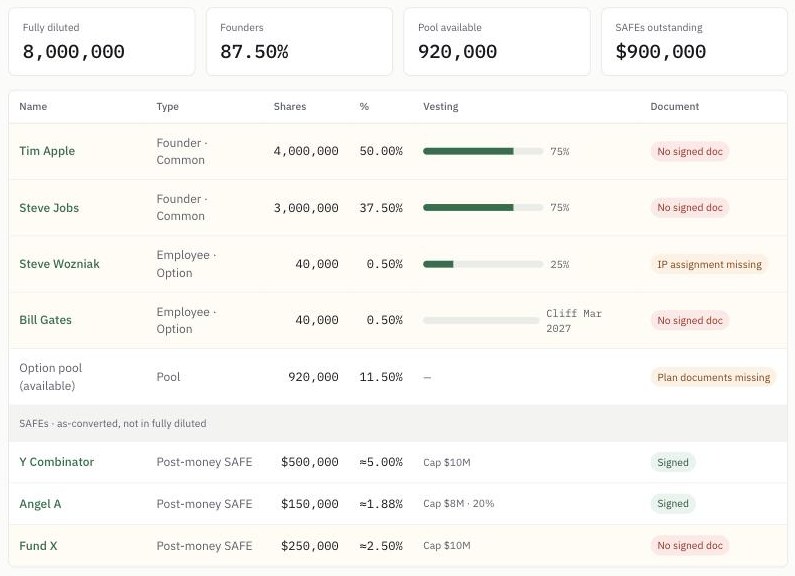
In Acme, Capfolder's sample company, Steve Wozniak holds 40,000 ISOs at a strike of $0.12, granted in October 2025 with four-year vesting. At the grant-date value, the whole grant is $4,800 of stock, far under the $100,000 a year limit, so all of it can be ISOs.
Suppose in 2028 the shares are worth $2.00 and he exercises 20,000 vested options, paying $2,400. The spread is ($2.00 − $0.12) × 20,000 = $37,600. With ISOs, there is no regular income tax on that, but it is added to his income for the alternative minimum tax (AMT), which may or may not mean tax that year. With NSOs, that $37,600 would be ordinary income, with withholding, in 2028.
If he then holds the shares for more than a year and sells in 2030 for $5.00, an ISO gives him long-term capital gain on everything above $0.12. If he leaves Acme in 2028 and waits five months to exercise, his options have lost ISO status under the 3-month rule and are taxed as NSOs.
Which should a company grant?
Most US startups grant ISOs to employees, because they can be better for them, and NSOs to everyone who isn't an employee, because ISOs aren't allowed for them. Some companies give longer exercise windows after leaving, such as several years. That is employee-friendly, but past three months those options become NSOs anyway. Grants to people outside the US follow their own country's rules; ISOs are a US concept.
Outside the US
ISO and NSO are US tax terms. If you hire people in other countries, their options follow local rules, and many countries have their own tax-advantaged schemes, such as EMI options in the UK. A US company granting to a non-US employee usually grants an NSO-style option under a country addendum to the plan. Get local advice before the first grant in a new country.
Key terms
- Strike price: what you pay per share to exercise.
- Spread (bargain element): fair market value at exercise minus the strike price, times the number of shares.
- AMT: the alternative minimum tax, a parallel US tax calculation. The ISO spread at exercise counts toward it.
- Qualifying disposition: selling ISO shares after both holding periods, two years from grant and one from exercise.
- Early exercise: exercising before vesting, if the plan allows. Combined with an 83(b) election it can start holding periods earlier.
Questions to ask before exercising
- Are my options ISOs or NSOs? Check the grant agreement, and whether any part went over the $100,000 limit.
- What is the current fair market value? The latest 409A sets the spread.
- How will I pay? The strike price, plus, for NSOs, withholding tax on the spread.
- Will the spread trigger AMT? For ISOs, a tax advisor can estimate it before you exercise.
- Can I hold the shares? Private company shares can't usually be sold. Only exercise what you can afford to hold, possibly for years.
- When does my window close? Especially after leaving: three months for ISO treatment, and whatever the plan says for the option to expire.
Common mistakes
- Granting ISOs to advisors or contractors. They aren't eligible; the grant is an NSO whatever it says.
- Ignoring the $100,000 rule on large or accelerated grants. The excess is silently NSO.
- Missing the 3-month window after leaving, and losing ISO treatment.
- Surprise AMT from exercising ISOs on a large spread. Run the numbers with a tax advisor first.
- Not recording the type. The cap table and the grant agreement should both say ISO or NSO.
In Capfolder
Each option grant records its type, ISO or NSO, its strike price and its vesting. When someone leaves, their page shows the last day to exercise, so the 90-day window doesn't slip by unnoticed.
Questions people ask
Can a contractor receive ISOs?
No. ISOs are only for employees. Contractors, advisors and non-employee directors get NSOs.
What is the ISO $100,000 limit?
Only options on up to $100,000 of stock, valued at the grant-date price, can first become exercisable in a calendar year as ISOs. The rest are treated as NSOs.
What happens to ISOs when I leave the company?
To keep ISO treatment you must exercise within three months of leaving (one year for disability). Options exercised later, if the plan allows it, are taxed as NSOs.
Are ISOs always better than NSOs?
Often, but not always. Exercising ISOs can trigger the alternative minimum tax, and the holding periods tie up your money. It depends on your situation.
What is a disqualifying disposition?
Selling ISO shares within two years of the grant or one year of exercise. Part of the gain is then taxed as ordinary income.
Can a grant be part ISO and part NSO?
Yes. When a grant goes over the $100,000 limit, the part above it is treated as NSO automatically.
Do NSOs have a holding period?
Not for the exercise tax. After exercising, holding the shares more than one year makes later gains long-term capital gains.
Sources
- 26 U.S. Code § 422: Incentive stock options (primary source)
- IRS Topic 427: Stock options (primary source)
- Carta: Incentive stock options (topic coverage)
- Carta: Non-qualified stock options (topic coverage)
Read next
Not legal or tax advice. Tax rules change and depend on your situation: check yours with a tax advisor or lawyer. Spotted a mistake? Tell us on GitHub.