
The problem it solves
Founders often receive their shares at day one, for a tiny price, subject to vesting: if they leave early, the company can buy back the unvested part. Section 83 of the US tax code treats shares like that as income only when they vest, and taxes the value at that moment.
That is a trap for a growing startup. If the company is worth much more three years later, every monthly vesting step is taxable income at the new, higher value, even though you can't sell the shares to pay the tax. The 83(b) election lets you choose to recognise the income now, on the value today, and nothing more as the shares vest.
An example: Acme's founders
Tim Apple received 4,000,000 shares of Acme on 14 September 2021 at $0.00001 per share, so he paid $40, subject to four-year vesting. On that day the shares were worth what he paid.
- With an 83(b) election: income on 14 September 2021 = value minus price paid = $0. No tax due, and his capital gains holding period starts that day.
- Without one: each month as shares vest, the value of the newly vested shares at that time is ordinary income. If Acme's shares were worth $1.00 when a block of 83,333 vested, that is $83,333 of taxable income that month, with no cash from the shares to pay it.
For founders who pay full value for their shares, filing usually costs nothing and removes a large risk. That is why lawyers treat it as close to mandatory.
Who should consider filing
- Founders who receive restricted stock subject to vesting.
- Employees and advisors who receive restricted stock awards (RSAs).
- Option holders who early exercise: buying shares before the options vest, when the plan allows it.
It does not apply to ordinary stock options you haven't exercised, or to RSUs. With those you don't own property yet, so there is nothing to elect on.
How to file
- Count the days. The deadline is 30 days after the date the shares were transferred to you (the issue date on your stock purchase agreement), not 30 days after you signed something else.
- Fill in the election. The IRS published Form 15620 for this in 2024. A signed letter with the same information also works: your name and taxpayer ID, a description of the shares, the transfer date, the restrictions, the value, and the amount you paid.
- Send it to the IRS at the address where you file your tax return. Use a delivery method with proof of the mailing date, such as certified mail with a return receipt.
- Give a copy to the company, and keep one yourself with the proof of mailing. You no longer have to attach a copy to your tax return.
If you miss the 30 days, the election is gone. The IRS does not grant extensions, and the fix afterwards, if any, is expensive.
The risks
- Paying tax on something you might lose. If the shares are worth more than you paid, you pay tax now. If you then leave and the company buys back the unvested shares, you can't get that tax back.
- No undo. Once filed, the election can only be revoked with the IRS's consent, which is rare.
- State and non-US rules. This is US federal tax. State rules usually follow, but if you live elsewhere your own country's rules apply.
Key terms
- Restricted stock: shares you own now but that the company can buy back if you leave before they vest.
- Substantial risk of forfeiture: the tax code's term for that vesting condition. While it lasts, Section 83 normally delays the tax.
- Fair market value: what the shares are worth on the transfer date. For founders at formation, usually the tiny price they pay.
- Early exercise: exercising options before they vest, which gives you restricted stock, so the 30-day clock starts on exercise.
- Holding period: how long you have owned the shares for capital gains purposes. With an 83(b) it starts on the transfer date.
What the election must say
Whether you use Form 15620 or a letter, the IRS needs:
- your name, address and taxpayer identification number;
- a description of the shares, such as "4,000,000 shares of common stock of Acme Inc.";
- the date of transfer and the tax year it is for;
- the nature of the restrictions, such as the company's right to repurchase unvested shares;
- the fair market value at transfer, ignoring the restrictions;
- the amount you paid;
- a statement that you have given copies to the people required, such as the company.
Many company lawyers prepare a ready-to-sign election with the stock purchase agreement. If yours didn't, ask for one on the day you sign.
Common mistakes
- Missing the deadline because nobody told you. It is the most common and most expensive cap table mistake lawyers find.
- No proof of mailing. In due diligence, investors' lawyers ask for the election and proof it was sent in time.
- Company has no copy. The company needs one for its records.
- Filing for unexercised options. It does nothing, and it can confuse your records.
In Capfolder
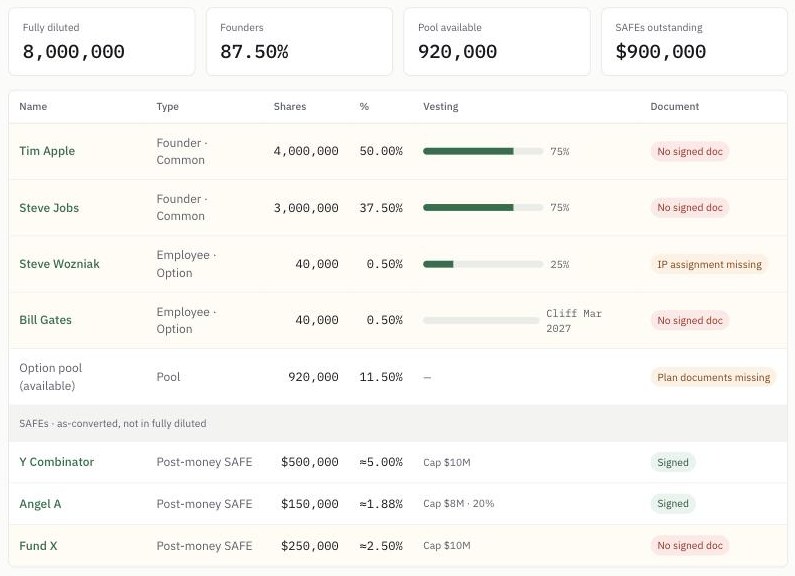
Attach each person's 83(b) election and proof of mailing to their share issuance. Capfolder lists founders and restricted stock holders with vesting but no 83(b) on file under What's missing, so the gap shows up long before an investor's lawyer finds it.
Questions people ask
What is the 83(b) deadline?
30 days after the shares are transferred to you. The IRS does not grant extensions.
Do I need to file an 83(b) for stock options?
Not for ordinary unexercised options. It is for restricted stock, including shares bought through an early exercise of options.
What form do I use?
IRS Form 15620, published in 2024, or a signed letter with the same information. Send it to the IRS office where you file your return.
Do I attach the 83(b) to my tax return?
No longer. That requirement was removed in 2016. Keep your own copy and proof of mailing, and give a copy to the company.
Can I file an 83(b) late?
No. A late election is not valid. Talk to a tax advisor about what can still be done.
Does my spouse need to sign?
Not for the federal election itself. Some lawyers add a spouse consent for community property states. Ask yours.
Who files the 83(b), me or the company?
You do. The company can prepare it, but the election is yours, and the company only needs a copy.
Sources
- 26 U.S. Code § 83(b): election to include in gross income in year of transfer (primary source)
- IRS Form 15620: Section 83(b) Election (primary source)
- IRS Revenue Procedure 2012-29: examples of 83(b) elections (primary source)
- Cooley GO glossary: 83(b) election
Read next
Not legal or tax advice. Tax rules change and depend on your situation: check yours with a tax advisor or lawyer. Spotted a mistake? Tell us on GitHub.