How dilution works
Your percentage is your shares divided by all shares. When new shares are created, the bottom of that fraction grows and the top stays the same.
New ownership = your shares ÷ (old total + new shares)
Dilution factor = old total ÷ new total
Every existing holder is diluted by the same factor in an ordinary issuance. If the total grows by 25%, everyone keeps 80% of their old percentage.
What causes dilution
- Priced rounds: new preferred shares are sold to investors.
- SAFEs and convertible notes converting at the next round.
- Option pool increases, often required by investors as part of a round.
- Warrants being exercised, and shares issued to advisors or in an acquisition.
Note what does not dilute you on a fully diluted basis: an employee exercising options already granted from the pool. Those options were already counted. On an issued-shares basis, they do.
An example: Acme from today to after a seed round
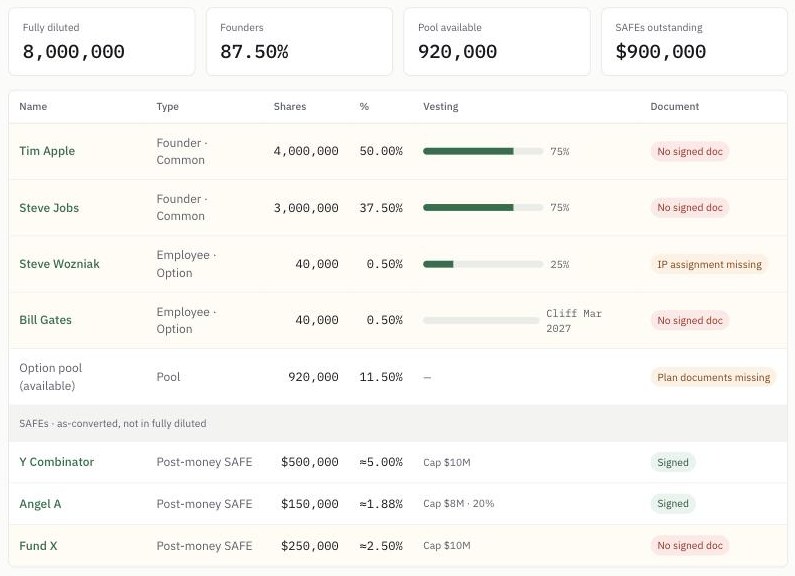
Acme, Capfolder's sample company, has 8,000,000 shares fully diluted and $900,000 of post-money SAFEs that together will own 9.375% just before the next round. Suppose Acme then raises $2,000,000 for 20% of the company. We follow Tim Apple's 4,000,000 shares.
| Step | Total shares | Tim Apple |
|---|---|---|
| Today, fully diluted | 8,000,000 | 50.0% |
| SAFEs convert (9.375%) | ≈ 8,827,600 | 45.3% |
| Seed round (20% sold) | ≈ 11,034,500 | 36.3% |
Tim still has 4,000,000 shares. His percentage fell from 50% to about 36% in two steps. If the seed round valued the company at, say, $1.20 per share, his stake went from a paper value near zero to about $4.8 million. That is the trade every founder makes: less of something worth more.
If investors also asked for a pool top-up counted before the round, Tim's percentage after the round would be lower still. Our Option pool page explains why.
Dilution over several rounds
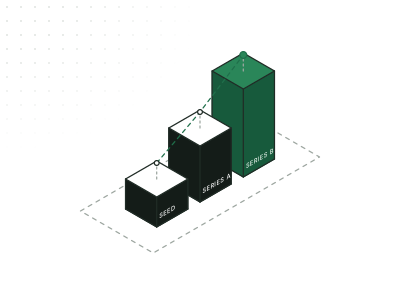
Each round multiplies. Selling 20% at seed, 20% at Series A and 15% at Series B leaves the earlier holders with 0.8 × 0.8 × 0.85 = 54% of what they started with, before any pool increases. A founder starting at 50% would end near 27%. That is why founders plan dilution across rounds, not one round at a time.
Value dilution and anti-dilution
Percentage dilution is expected. Value dilution, where your shares become worth less per share, happens in a down round, when new shares are sold below the previous price. Preferred investors usually have anti-dilution protection for that case. The common version, broad-based weighted average, gives them some extra shares when the price drops; the harsher "full ratchet" resets their price to the new low one. Either way the extra shares come from the common holders, which is one more reason to raise at a price you can grow into.
Dilution for employees
Employees with options are diluted too. Steve Wozniak's 40,000 options are 0.5% of Acme fully diluted today. After the SAFEs convert and a seed round sells 20%, they are about 0.36%. His option count doesn't change and neither does his strike price; only the slice gets smaller. If the round prices the shares well above his $0.12 strike, his options are worth far more than before, even at the smaller percentage.
That is worth explaining to the team when you raise. People who track their percentage can be surprised by the drop; people who understand the trade usually aren't. Showing the number of options, the strike and the latest share price tells a clearer story than the percentage alone.
Key terms
- Issued and outstanding: shares that exist today. Percentages on this basis change when options are exercised.
- Fully diluted: issued shares plus all options, the whole pool and warrants. The basis investors use.
- As converted: fully diluted plus the shares the SAFEs and notes are expected to convert into. An estimate until the round closes.
- Down round: a round at a lower price per share than the previous one.
- Pro rata right: an investor's right to buy into new rounds to keep their percentage from being diluted.
How to plan for dilution
- Start from today's fully diluted table. Include the whole pool.
- Add the SAFEs at their caps to get the as-converted table.
- Model the next round: how much you will raise, the percentage you expect to sell, and the pool the investors will ask for.
- Repeat for one or two more rounds with rough assumptions.
- Look at the result for each founder and the team. Are the founders still motivated at that stake? Is there enough pool to hire the team you need?
This is not about predicting the future exactly. It is about seeing the shape: how much each kind of event costs, and which ones you can still negotiate.
Common mistakes
- Planning one round at a time. Model two or three rounds ahead to see where the founders end up.
- Forgetting the SAFEs. They convert at the same moment as the round and dilute the founders first.
- Ignoring the pool top-up. It can cost founders several more points.
- Comparing different totals. A percentage on issued shares and one on fully diluted shares can't be compared.
- Fearing dilution itself. Raising less than you need to avoid dilution can cost more than the dilution.
In Capfolder
Capfolder shows each holder's percentage on a fully diluted basis, with the SAFEs listed under the cap table and an as-converted estimate, so you can see how much of the company is already spoken for before you talk to investors.
Questions people ask
How do you calculate dilution?
Divide the old total number of shares by the new total. Multiply your old percentage by that factor to get your new percentage.
Does dilution mean I lose money?
Not necessarily. You own a smaller percentage, but if the new money values the company higher, your shares can be worth more.
Do employee options dilute founders?
Granting them from an existing pool doesn't change fully diluted percentages, because the pool was already counted. Creating or increasing the pool does.
What is anti-dilution protection?
A term that gives preferred investors extra shares if the company later sells shares at a lower price. The extra shares dilute the common holders.
How much dilution is normal per round?
Many seed and Series A rounds sell 15% to 25% of the company, but it varies widely by market and company.
Do I need to agree to be diluted?
New shares are issued by the board and, for many changes, approved by shareholders. Founders who control the board and the vote decide, but investors' rights in their documents often require their consent too.
What is a pro rata right?
An investor's right to buy part of a later round so their percentage doesn't drop. It protects them from dilution if they pay in.
Sources
- Carta: Share dilution, what causes it and how to prepare (topic coverage)
- Cooley GO glossary: dilution
- Y Combinator Library: Understanding SAFEs and priced equity rounds
- Wikipedia: Stock dilution
Read next
Not legal or tax advice. Every company's documents are different: check yours with a lawyer. Spotted a mistake? Tell us on GitHub.